Teachable or Kajabi? Which Is the Best Course Tool to Use in 2022?
ebridge
Feb 20, 2023 · 10 min read
If you are here, you probably already know that Teachable and Kajabi are two incredibly well-liked and best online course platforms. They are terrific tools for designing and selling online courses but have different purposes.
Teachable makes it simple and quick to design and market online courses and is user-friendly for beginners. On the other hand, Kajabi provides a complete set of features that make managing a comprehensive online course business easier and, as a result, includes a wide range of marketing tools.
Which, however, is more advantageous for solopreneurs and lifestyle entrepreneurs? In this detailed comparison between Teachable and Kajabi, we will help you figure it out.
Who Should Remove the below automatic table of content before publishing
What Is Teachable?
Teachable offers an entirely free option. However, in contrast to Teachable, which lets you create and sell unlimited courses across all levels, Kajabi places limits on the number of products and procedures you can have on each plan (even the free plan).
Teachable is primarily a platform for creating online courses, but Kajabi is an all-in-one solution offering everything you need to develop and sell techniques.
The Following Pros and Cons are Teachable:
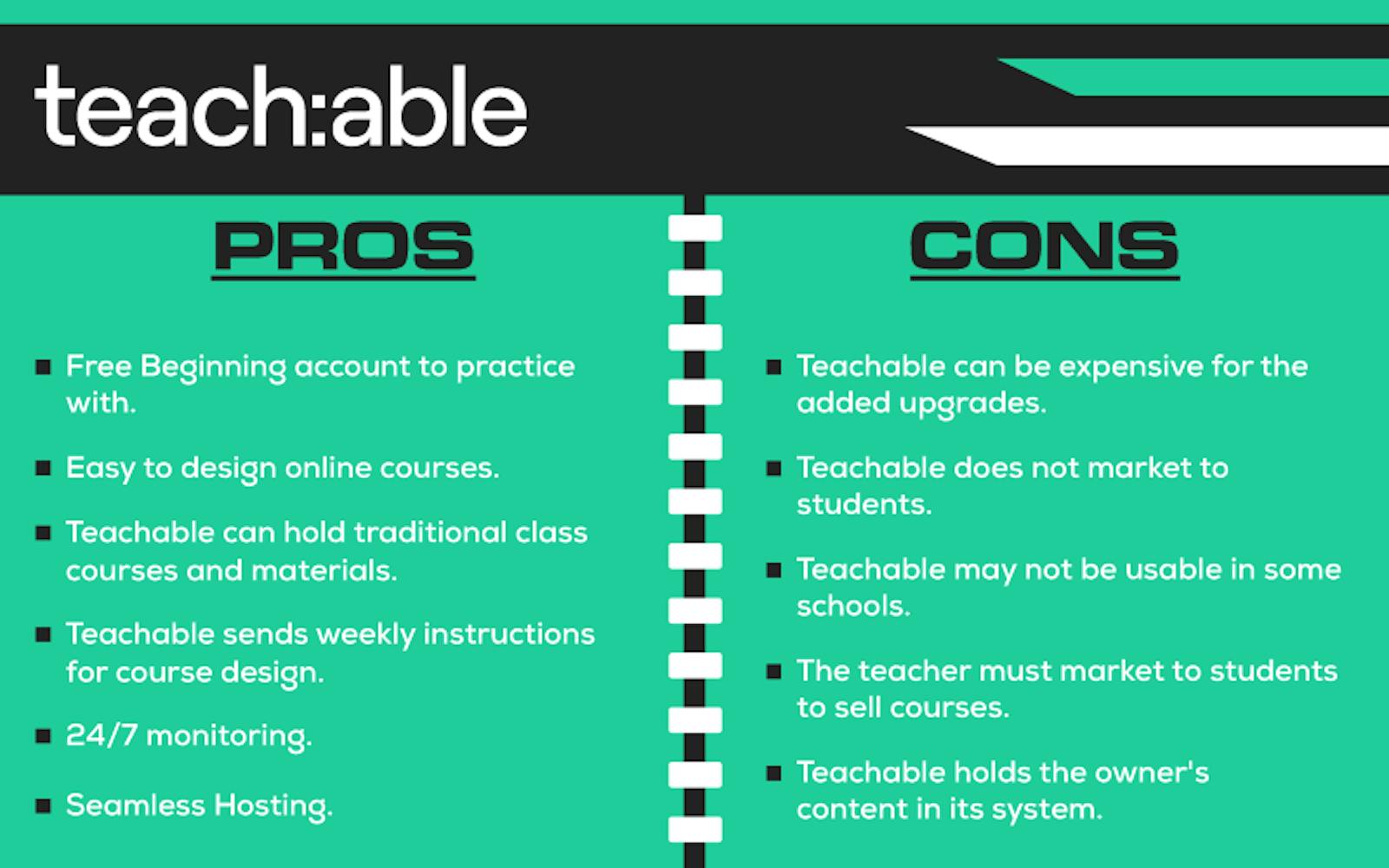
Pros of Using Teachable:
You can build online courses, memberships, and coaching services using Teachable. However, the tools creators and business owners should not restrict how they create and operate their enterprises.
Tools that attempt to meet your requirements on a single platform can be restrictive. Teachable concentrates on offering you more control and alternatives so you can create your Business your way, unlike Kajabi and other all-in-one platforms.
Overall, it's an intuitive platform for all kinds of creators—no prior design or coding knowledge is required.
- All Teachable plans allow you to build an unlimited number of courses. You can also accept a total number of students into your classes, unlike Kajabi, which, even in their higher plans, has restrictions for some students and courses.
- Teachable offers a free plan. However, there is a transaction cost of 10%.
- It is the most OK location to host academic courses because it has greater course compliance and certification programs. You can also provide classes in specialized areas like the arts, health, Business, etc. View more than 30 real-time examples of websites created with Teachable in different niches.
- Teachable has both an iOS and an Android app.
- It is more affordable (nearly three times as affordable) than Kajabi, making it more appealing to beginners.
Cons of Using Teachable:
- Few opportunities for customizing the course and website.
- No free plan is offered.
- A 5% transaction fee applies to the basic program.
- You must use a third-party platform to create sales funnels.
- You can only contact Teachable support via email.
- No market, of course.
- No possibility for multi-tenancy.
- No continuing education points.
- Only a few languages are supported.
What Is Kajabi?
Kajabi positions itself as a one-stop shop for operators of online course businesses. Kajabi has tools, including a website builder, email marketing, webinars, sales funnels, and more, allowing users to create online courses.

Kajabi frequently needs to catch up in features linked to courses because it tries to meet numerous technology-related objectives of online company owners.
For instance, it doesn't provide course compliance controls like certificates of completion. But on the other hand, Teachable has more functionality in its analytics reports, payout administration facilities, and tax tools than Kajabi.
The following pros and cons are Kajabi.
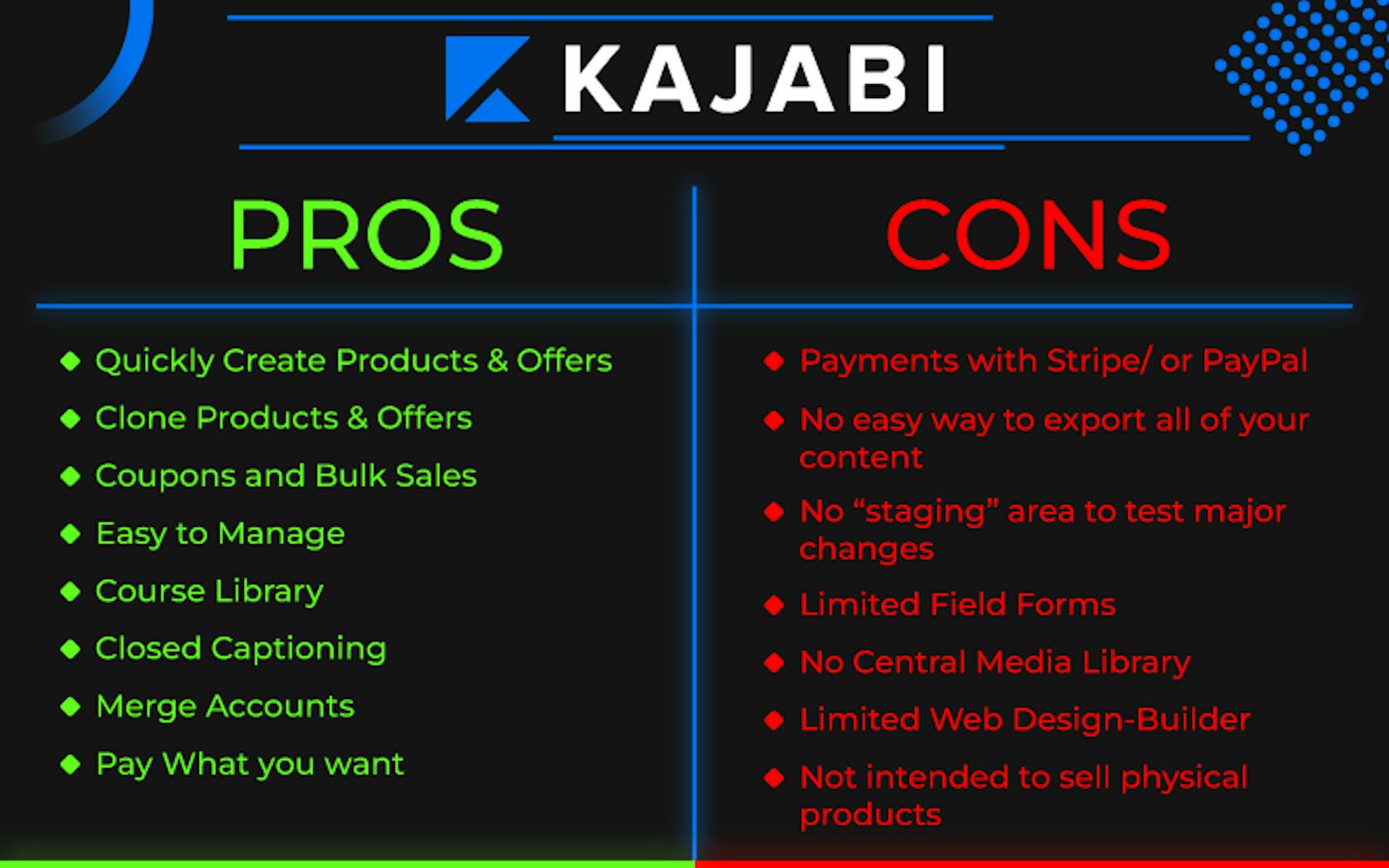
Pros of Using Kajabi
- Kajabi has markets similar to those of Udemy or Skillshare. Teachable does not, however, provide a marketplace.
- It is a complete platform with all the tools you might need to manage a business. Kajabi has all the necessary features, so there's no need to worry about integrating it with other devices.
- Kajabi does not charge a transaction fee, although the cost is high.
- Kajabi offers you 10+ themes, a ton of customization choices, and a website builder. On the other hand, Teachable has no design freedom very much unless you utilize their crazy power editor.
- Teachable lacks lecture-specific automation options, whereas Kajabi does not. For instance, you may attach a tag or email the student when they complete a particular lesson, like a marketing video.
- It provides fantastic engagement mechanisms like communities, assignments, exams, etc., even though Teachable offers a comments section.
Cons of Using Kajabi
- There isn't a way to create tests inside the course material.
- Live video conferencing is not included in Kajabi's platform or the lessons.
- The support team needs to step up their game by making themselves more approachable to customers and precise in their responses to their questions.
KAJABI VS. TEACHABLE: A DETAILED COMPARISON
Here is a detailed comparison of Teachable vs. Kajabi to help you make an informed decision.
The major platforms to create a successful online business, Kajabi & Teachable, are compared in depth to highlight their key distinctions.
Interface & Ease-Of-Use
It will be more challenging to create online courses if the platform for online courses has a complicated user interface. Fortunately, Teachable and Kajabi make it easy for even a rookie course builder.
- Teachable
Teachable has a simple user interface with quick access to all functions and options via the left menu.
Sub-items under each item in the left sidebar provide access to additional functions. Beginners will like how easy and plain the navigation is.
- Kajabi
With a left sidebar where you can access all the tools and capabilities, Kajabi also provides a corresponding user interface.
However, menu elements are deeply layered in contrast to Teachable. The Kajabi Assistant, essentially a search feature, will be helpful to you.
Design and Personalization
We will discuss Teachable and Kajabi's design and personalization choices for site-specific personalization.
- Teachable
Teachable offers some beneficial site-level customization options.
You can update the platform's custom text used in various locations, add code snippets (for retargeting and other scripts), add pages, change the default navigation and theme, and use the power editor.
You can alter the text using the "custom text" feature, which is impossible. Unfortunately, Kajabi does not have this functionality.
You might substitute a message like "Card declined, please try a different card or email us at info@ebridge.tech for alternative payments" for the standard one that reads "The card was declined."
The Teachable professional plan's Power Editor is a competent editor that lets you modify every site component without any coding experience.
Teachable needs a complete visual builder like Kajabi. Additionally, you have a few themes at your disposal.
- Kajabi
Kajabi will launch the visual builder when you begin designing any landing page.
You can utilize numerous elements in the constructor, which is quite flexible, such as counters, accordions, films, opt-in forms, and many other things.
In addition, Kajabi allows you to design your landing pages by utilizing its powerful visual builder.
Integrations Compared:
Kajabi and Teachable offer many connectors; however, there are minor variations.
- Teachable
On the other hand, Teachable does not support webhooks but offers a large selection of pre-configured integrations AND Zapier connections. For most use cases, this makes it far more usable and accessible.
For instance, Teachable has direct integrations with numerous top email service providers (ESPs) via Zapier.
Additionally, they immediately link with well-known platforms like Google Analytics, Sumo, Mailchimp, ConvertKit, and others (in the Teachable dashboard).
- Kajabi
"Webhooks," which enable direct data connection across various applications (great for payment gateway integration), is a technical integration method that Kajabi offers.
Nevertheless, despite some helpful help desk literature, it could be a more user-friendly integration for the ordinary operator.
Course Creation:
- Teachable
Teachable: this asks you for certain information when you create a new course and allows you to fill up the curriculum. You can designate sections and place lectures inside each of them.
You may clearly outline your course structure by using these. You can use virtually any content when designing a new lesson, including videos, files, text, quizzes, and custom code (if you want to embed something).
- Kajabi
What can create three courses in Kajabi: mini-courses, online courses, and evergreen training (drip content)?
It takes some time for Kajabi to build your product when you click the "Create course" button. The module or segment is referred to as a category in Kajabi. You can also have subcategories within each category.
You can have several posts within each of these categories and subcategories. Additionally, you can add specific actions to the student profile when they finish a lecture using the automation option available for each class.
This is a feature that makes Kajabi incredibly special.
Selling and Marketing Your Course:
It's time to market and sell your digital product when you've finished creating its content. Both Teachable and Kajabi offer a selection of options for monetizing courses.
- Teachable
You've connected all of your courses, including engaging videos, created a stunning sales page, and are now prepared to make a sale. In this area, Teachable excels.
Using Teachable student referral and affiliate marketing tools, spreading the word about your course is simple. Encourage current customers to refer friends to your digital product in exchange for discounts.
Even better, get other well-known artists to advertise your products as affiliates. Finally, give affiliates a cut of any sales made due to their marketing initiatives.
- Kajabi
When it comes to promoting and selling your digital items, Kajabi is advertised as an all-in-one business solution.
Marketing tools, including a dedicated email marketing tool, live webinars, upsells, and affiliate marketing, are all included in Kajabi.
However, there are a few crucial limitations to these marketing tools' powers that must consider.
Kajabi's email marketing tool is integrated into the site, although it lacks several sophisticated features that may be found on more established email marketing platforms like MailChimp.
Similarly, the webinar capability is minimal and does not provide the same levels of personalization and segmentation as services.
Pricing Plans:
When selecting an online education instrument, the cost is one of the critical determining considerations. After all, if you don't have the cash for it, to begin with, adding features frequently won't help.
- Teachable
Teachable provides a wide range of highly flexible payment options. Either monthly or annual options are available for registration.
Following are the three Teachable pricing tiers: (Basic: $29 per month with annual billing; Pro: $99 per month with annual billing; and Business: $249 per month with yearly billing.)
You can sign up for a teachable free plan without providing your credit card information if you want to try it out and see how everything works.
- Kajabi
The cost for Kajabi is as follows:(Basic: $119 monthly, payable yearly; Increasing: $159 monthly billed yearly; and Pro Plan: $319 monthly, paid annually). These are offered at a 20% discount from monthly-billed plans.
Users of the other two plans are immune from the transaction fee that comes with Kajabi's Basic plan. Every scenario has been carefully selected with a particular target audience.
Although Kajabi doesn't have a free plan, they provide a 14-day trial, so you may use the program and see how it functions.
Summing It Up: The Best Online Course Platforms:
Teachable excels in course compliance, certificate creation, and pricing, whereas Kajabi excels in sales funnels, email marketing, course page creation, and automation.
Teachable is also a fantastic, more affordable choice for beginners. Additionally, it functions better for those who already have other aspects of their organization under control, such as marketing and automation.
Teachable, however, isn't scalable. So when your company grows, you'll need to switch to a different platform like Kajabi.
Although Kajabi offers many more third-party connectors and functionality than Teachable and is more potent in some areas, business demands can vary.
The cost is another consideration. Teachable is more straightforward but affordable, whereas Kajabi is more expensive but more sophisticated.
The Final Verdict
Well, that depends on the scale and nature of the company. Teachable is the ideal option for small businesses and bloggers who want to add an online course as an additional source of revenue to their Business.
You can get started for free or choose a reasonably priced paid plan if you want more capabilities. Kajabi is a comprehensive and highly advanced course platform if you are up for a premium experience.
Looking for more information regarding the best online course platforms? Get in touch with us today.